

Construction delays cost money in ways that go well beyond the calendar. Labor gets stretched thin. Equipment sits idle while the meter keeps running on the rental agreement. Overhead accumulates — supervisors, trailers, insurance, and site security don’t stop costing money just because the work has stalled.
Sometimes delays are your fault. Other times they belong to the owner, the designer, or forces nobody controls. When the owner (or someone acting on the owner’s behalf) causes the delay, you generally have the right to recover the added costs. But recovering on a delay claim isn’t automatic — it requires proof, and proof requires documentation built while the delay is happening, not reconstructed afterward. If you’re unsure where your situation stands, the team at Construction Lawyer can walk through the specifics with you.
Types of Construction Delays
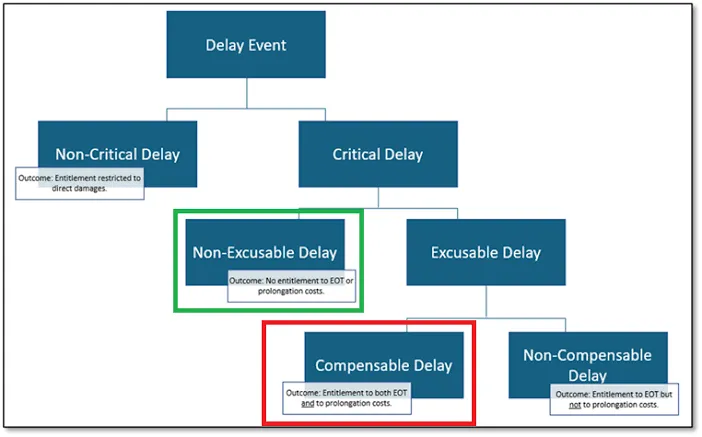
Not all delays are treated the same way under a construction contract. Courts and arbitrators typically sort them into three categories, and which category a delay falls into determines whether you get more time, more money, or neither.
Excusable Delays
Excusable delays are events outside your control: severe weather beyond what’s normal for the season, unforeseen subsurface conditions, natural disasters, or sudden regulatory changes. Most standard contract forms (including AIA and ConsensusDocs templates) treat these as grounds for a time extension.
The key point: excusable delays are usually not compensable. You get relief from liquidated damages and a later completion date, but not a check. The theory is that neither party caused the event, so neither party should have to pay for it — the risk of “acts of God” is shared through a schedule extension rather than a payment.
Non-Excusable Delays
Non-excusable delays are the contractor’s own doing — a crew that doesn’t show up, a subcontractor that fails to perform, a materials order placed too late. These delays don’t earn a time extension, and they can expose you to liquidated damages: a per-day penalty specified in the contract for late completion. Courts will generally enforce a liquidated damages clause as long as the amount was a reasonable pre-estimate of the owner’s likely harm at the time of signing, rather than a punitive number designed to coerce performance.
Concurrent Delays
Concurrent delays happen when both the owner and the contractor are independently causing delay on the critical path at the same time. This is the hardest category to resolve. Many jurisdictions apply some version of the rule that neither party can recover delay damages from the other during a period of true concurrency — each side effectively absorbs its own costs for that overlapping stretch — though contract language can modify this default. Because outcomes vary significantly by state and by contract clause, this is an area where getting a schedule expert or attorney involved early tends to pay for itself.
Compensable Delays
Compensable delays are caused by the owner (or the owner’s agents, like the architect or engineer), and they entitle you to both a time extension and money. Common triggers include:
-
Late approval of design changes or submittals
-
Failure to give the contractor timely access to the site
-
Delayed permits or approvals where the owner controlled the paperwork
-
Owner-directed suspensions of work
-
Defective specifications that require rework
Critical Path Analysis: Your Schedule Is Evidence
A delay claim lives or dies on critical path analysis. Your project schedule isn’t just a planning tool — it’s the primary evidence you’ll use to prove causation.
Build a baseline schedule (a Critical Path Method, or CPM, schedule) at the start of the project and keep it updated. The critical path is the sequence of tasks that determines the earliest possible completion date; any delay to a critical-path task pushes the finish date back by the same amount. Tasks not on the critical path have “float” — slack time — and can slip without affecting the completion date at all.
This distinction matters enormously in a claim. A delay to a non-critical task, even a significant one, generally doesn’t support a delay claim, because it didn’t actually push out the finish date. Owners’ counsel will look for exactly this gap, so before you submit a claim, run a time-impact analysis showing how the specific delay event moved the critical path — not just that a delay happened somewhere on the job. For a deeper look at the methods used to build this kind of analysis, see this overview of CPM delay analysis.
Documentation Requirements
Memory is not evidence. Delay claims are won or lost on the strength of contemporaneous records — documentation created at the time events happened, not reconstructed weeks or months later.
Daily logs. Record crew size, tasks performed, weather conditions, equipment on site, and any problems or obstacles encountered, every working day. A daily log that mentions a stop-work instruction on the date it happened carries far more weight than a memo written after the fact.
Change order documentation. Any time the owner or architect directs a change — in scope, sequence, or design — get it in writing, and describe its schedule impact at the time, not retroactively.
Photographs and site records. Dated photos, RFI logs, meeting minutes, and correspondence all corroborate the story your schedule is telling. Courts and arbitrators consistently give more weight to records generated in the ordinary course of the work than to after-the-fact narratives, however accurate those narratives might be.
Notice. Nearly every construction contract has a notice provision requiring you to tell the owner about a delay — often within a strict window like 7, 14, or 21 days of when it started. Missing this deadline can waive the claim entirely, regardless of how strong your underlying case is. Calendar these deadlines the moment a contract is signed, and treat them as hard cutoffs.
Calculating Delay Damages
Impact Costs
Impact costs flow from lost productivity: a crew that can’t be kept fully busy, equipment that sits idle on the meter, and materials that have to be stored, re-handled, or re-ordered. These are usually calculated by comparing actual labor and equipment costs during the delay period against what a normally productive period should have cost — often using industry productivity-loss studies (such as the Mechanical Contractors Association MCAA factors) to support the comparison.
Extended Overhead
Extended overhead is the added cost of keeping site supervision, general conditions, and home-office support in place longer than planned. The most common method for calculating unabsorbed home-office overhead is the Eichleay Formula, developed from federal contract disputes and widely (though not universally) accepted by state courts:
-
Divide the contract billings by the contractor’s total billings for the contract period to get a ratio.
-
Multiply that ratio by total home-office overhead for the same period to allocate overhead to the project.
-
Divide the allocated overhead by the original contract days to get a daily overhead rate.
-
Multiply the daily rate by the number of compensable delay days.
The Eichleay method has real limitations — some jurisdictions require you to show you were actually on “standby” and unable to take on replacement work during the delay — so check how your governing law treats it before relying on it exclusively.
Acceleration Costs
If you sped up work to hit the original deadline despite an owner-caused delay — through overtime, added shifts, or extra crews — those acceleration costs are recoverable when the underlying delay was compensable. Document the acceleration decision itself (ideally in writing, showing it was a response to the owner’s action) since acceleration claims are frequently challenged as a contractor’s own scheduling choice rather than a forced response.
The Delay Claims Process
-
Give notice within whatever window your contract specifies — this is usually the single most common way legitimate claims get defeated.
-
Document as you go. Don’t wait for the project to end to start building your file.
-
Run the critical path analysis to show exactly how the delay event moved the finish date.
-
Calculate damages using a defensible method for each cost category — impact, overhead, and acceleration.
-
Follow your contract’s claim procedures exactly, including any required format, backup documentation, or claim submission deadlines.
-
Preserve everything — daily logs, RFIs, change orders, emails, schedule updates, and photographs — through resolution of the claim, including any statute-of-limitations period for a later lawsuit if negotiation fails.
Case Study Examples
Weather delay. A hard freeze in January halts concrete work. The contract treats weather delays as excusable but non-compensable — you get more time, not more money. But if the owner failed to provide heated enclosures that the contract required for winter work, the calculus changes: the delay is now attributable to the owner’s failure, and becomes compensable.
Design changes. The owner requests additional square footage mid-project. That’s a change order, and if the schedule impact analysis shows it pushed the critical path six weeks, you’re entitled to recover six weeks of extended overhead plus any associated impact costs.
Permit delays. A city takes longer than usual to issue permits — generally an excusable delay outside anyone’s control. But if the delay traces back to the owner submitting incomplete or incorrect paperwork, the owner caused it, and it becomes compensable.